
The Christian Family and Christian Walk
Your Family, and the Path You Walk as a Christian
Family Matters
The Christian Family is a little church, a little government and a little society. It shapes the foundation of the church, and of society itself. Future generations depend on the leadership found in the home, and the values they receive there.
The Family is a God-ordained institution, a spiritual and organic unity, that was established for the cultural mandate of 1) glorifying the Creator, and 2) subduing the earth. In this mandate (Genesis 2) the duties of the husband, wife, children, masters and servants are encompassed, and the Scriptures readily set forth a theology of domestical duties. Husbands, wives and children have specific, God-honoring duties to perform in their respective stations in the economy of God’s redemptive plan. Their goal as a family is to 1) honor God, 2) edify the church and 3) promote Christian values in their respective stations of society. All this stems from the moral and spiritual values enumerated in the home and functioning to honor Christ Jesus. In this regard was the Puritan conception of the family or household. Dr. William Perkins described the family as a “little church”, Dr. William Gouge called it the “seminary of the Church and commonwealth…” and Rev. Richard Baxter characterized the home as “a church… a society of Christians combined for the better worshipping and serving God.” Rev. Lewis Bayly taught that “what the preacher is in the pulpit, the same the Christian householder is in his house.” He was quoting Augustine. The family, then, is the most important institution in society paralleling the relationship of Christ and the Church. Thus, Paul, carried by the Holy Spirit, rightly demonstrates this in Ephesians 5:22-6:9 in the manner of the duty of the husband, of the wife, of the children, and of masters and salves in the household.
Based on the Bible and the Directory for Family Worship, if someone asked, “What should family worship look like in my daily routine,” this would be a suitable and helpful answer:
Family worship, according to the Directory for Private Worship, ought to be carried out daily in an ordered, reverent, and Scripture-governed manner. The steps below reflect that order, now grounded explicitly in the Word of God.
1. Gather the household.
The head of the home is to ensure that all under his charge are present and attentive.
“And these words, which I command thee this day, shall be in thine heart:
And thou shalt teach them diligently unto thy children, and shalt talk of them when thou sittest in thine house…” (Deuteronomy 6:6–7)
Joshua also declares the household duty plainly:
“But as for me and my house, we will serve the LORD.” (Joshua 24:15)
2. Begin with prayer.
Prayer is to be offered for the family, the church, rulers, and all men, with confession, thanksgiving, and supplication.
“I exhort therefore, that, first of all, supplications, prayers, intercessions, and giving of thanks, be made for all men;
For kings, and for all that are in authority…” (1 Timothy 2:1–2)
“And in that day ye shall ask me nothing. Verily, verily, I say unto you, Whatsoever ye shall ask the Father in my name, he will give it you.” (John 16:23)
3. Offer praise to God.
Prayer and praise belong together in the worship of God.
“Speaking to yourselves in psalms and hymns and spiritual songs, singing and making melody in your heart to the Lord.” (Ephesians 5:19)
“Praise ye the LORD. Praise the LORD, O my soul.” (Psalm 146:1)
4. Read the Scriptures.
The Word of God must be read plainly in the home.
“Till I come, give attendance to reading, to exhortation, to doctrine.” (1 Timothy 4:13)
“All scripture is given by inspiration of God, and is profitable…” (2 Timothy 3:16)
5. Make plain use of the passage.
After reading, the family should consider what God teaches—sins to avoid, duties to perform, warnings to heed, and promises to believe.
“But be ye doers of the word, and not hearers only, deceiving your own selves.” (James 1:22)
“Now all these things happened unto them for ensamples: and they are written for our admonition…” (1 Corinthians 10:11)
6. Catechize the household.
Instruction in sound doctrine is required, especially for children and those weak in understanding.
“And ye fathers, provoke not your children to wrath: but bring them up in the nurture and admonition of the Lord.” (Ephesians 6:4)
“For precept must be upon precept… line upon line…” (Isaiah 28:10)
7. Allow questions and instruction.
Members of the household may ask and learn, as truth is taught plainly.
“And when thy son asketh thee in time to come, saying, What mean the testimonies…?
Then thou shalt say unto thy son…” (Deuteronomy 6:20–21)
8. Give admonition when necessary.
The head of the household must correct sin and guide the family in holiness.
“Thou shalt teach them diligently unto thy children…” (Deuteronomy 6:7)
“Reprove, rebuke, exhort with all longsuffering and doctrine.” (2 Timothy 4:2)
9. Keep the exercise sincere and orderly.
Family worship must not be rushed, neglected, or treated lightly.
“God is a Spirit: and they that worship him must worship him in spirit and in truth.” (John 4:24)
“Let all things be done decently and in order.” (1 Corinthians 14:40)
10. Maintain secret worship alongside family worship.
Each person must also pray and meditate privately, morning and evening.
“But thou, when thou prayest, enter into thy closet…” (Matthew 6:6)
“My voice shalt thou hear in the morning, O LORD; in the morning will I direct my prayer unto thee…” (Psalm 5:3)
11. Special direction for the Lord’s Day.
Prepare for public worship, attend it, then review and apply what was heard.
“And they, continuing daily with one accord… did eat their meat with gladness…” (Acts 2:46)
“And these words… thou shalt teach them diligently…” (Deuteronomy 6:6–7)
“Take heed therefore how ye hear…” (Luke 8:18)
A simple daily pattern, grounded in Scripture, would look like this:
Gather the family.
Open with prayer.
Offer praise (sing or speak).
Read the Word of God.
Explain and apply the passage.
Catechize and instruct.
Admonish where needed.
Close with prayer.
This is not a bare routine, but a daily ordering of the household under Christ, where the Word governs, prayer ascends, and every soul is pressed toward godliness.
May this section of the website be for the edification of the family, and the respective duties of each hierarchical part of the family as ordained by God. Check out these works on reforming the family.
Articles:
- The Daily Exercise of God’s Word – by John Knox
- The Word of God and Family Prayer – by Rev. Thomas Doolittle
- What God Is to Families – by Rev. Thomas Doolittle
- A Remedy for Decaying Religion – by Rev. Oliver Heywood
- A Sad But Instructive History – by Rev. William S. Plumer
- Directives for Avoiding Dissension in the Home – by Rev. Richard Baxter
- The Duties of Husband and Wife – by Dr. John Dod
- Family Duty – by John Bunyan
- Family Worship – by A.W. Pink
- Great Duty of Family Religion – by Rev. George Whitefield
- Meditations For Household Piety – by Rev. Lewis Bayly
- Motives for Family Worship – by Dr. J. Merle D’Aubigne
- On the Family and Grace – by Jonathan Edwards
- Seven Reasons Families Should Pray – by Rev. Thomas Doolittle
- The Duties of Christian Parents – by Rev. J. C. Ryle
- The Duties of Husbands and Wives – by Rev. Richard Steele
- The Father and Family Worship – by Rev. J.W. Alexander
- The Mutual Duties Of Husbands and Wives – by Rev. Richard Baxter
- The Nature, Warrant, and History of Family Worship – by Dr. J.W. Alexander
- The Practice Of Piety At Meals – by Rev. Lewis Bayly
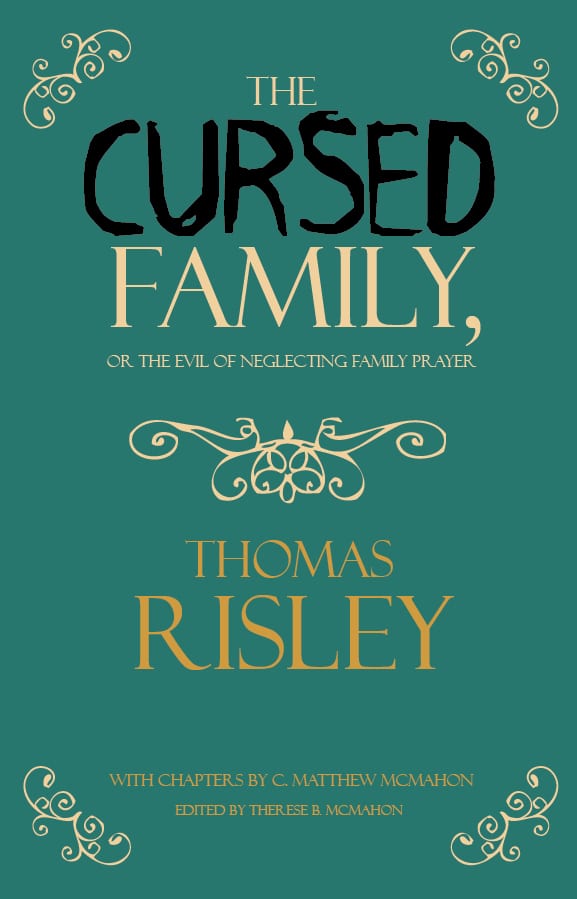
Thomas Risley (1630–1716) was an English Presbyterian minister with a tender pastoral heart, and a fiery preacher of Christ’s Gospel. Risley’s thesis is that wicked houses are under the curse of God, and are without his gracious keeping and fatherly care. He shows the responsibility of parents in family worship, for, to be without service to God in this way is to mimic a cursed family. SEE MORE HERE.

Help Support APM
