Jonathan Edwards (1703-1758)
The Works of Jonathan Edwards Online at APM
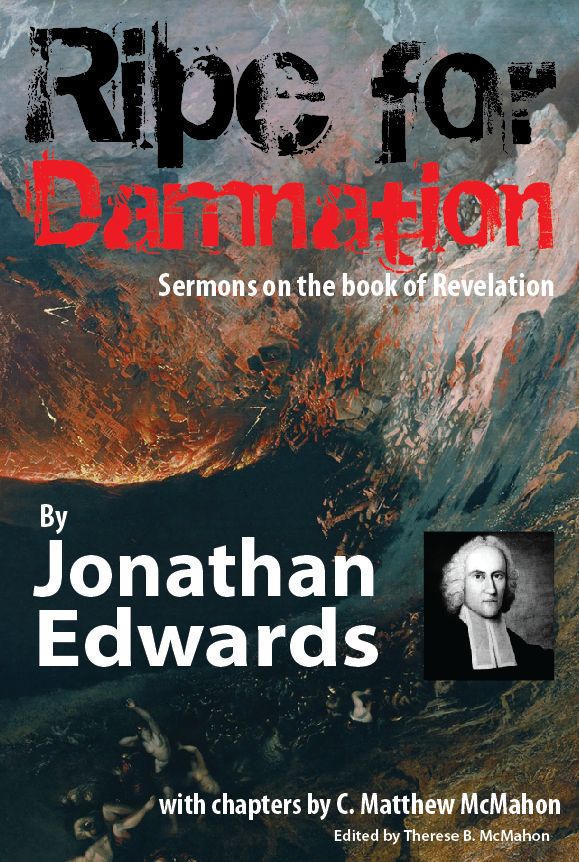
Ripe for Damnation: Sermons on the Book of Revelation – by Jonathan Edwards (1703–1758). Are you hungry for more of Edwards’ sermons? On the book of Revelation? These new works are not found anywhere on A Puritan’s Mind, and there are new ones not found in his large 2 volume works. 4 deal with the plight of the wicked, and 2 deal with the bliss of saints in heaven. These sermons are powerful, practical, and biblical, glorifying the Lord Jesus Christ, and contain 2 never before published sermons.

Justification by Faith Alone – by Jonathan Edwards (1703–1758). In this classic work, Edwards covers the intricacies of how believers are made righteous only through Christ’s merits, and that this justifying righteousness is equally imputed to all elect believers. This is accomplished by the condition of faith as an instrument.

One of the most important issues facing today’s contemporary church is the subject of public worship. What does God require from sinners who draw near to him in this ordinance? This anthology is compiled of six enlarged sermons and one lecture, all of which have never been published since the days the original preachers ministered in their respective congregations.
All of Edwards’ Popular Works
One will be hard pressed, outside of the Reformers and Puritans, to find sermons as insightful and biblically compelling as Edward’s sermons. He is, no doubt, the greatest preacher that God ever produced in America. The following section contains all his sermons that you would find in his two volume Works.
Jonathan Edwards (1703–1758) was a Reformed preacher, philosopher, and Congregationalist theologian. He is widely regarded as one of America’s most important and original philosophical theologians. Though not a Puritan himself, he stood squarely in their line, holding to the same Reformed theology that marked the Puritans before him.
His works are broad, ranging across a wide variety of biblical and philosophical topics—the will, the affections, original sin, the nature of true virtue, and the history of redemption. Yet for all their breadth, they never drifted from their roots. Edwards remained firmly anchored in Reformed theology and in the Puritan heritage that shaped him.
God used Edwards mightily in the First Great Awakening. In 1733–35, he oversaw some of its earliest revivals at his church in Northampton, Massachusetts, and he later wrote careful accounts of what God had done there, accounts still read today.
His most famous sermon, *Sinners in the Hands of an Angry God*, was preached during the revival of 1741, most memorably at Enfield, Connecticut, on July 8. As Edwards pressed home the terror of God’s wrath and the mercy of Christ held out to sinners, the congregation was so overcome that he could not finish. The sermon became a defining moment of the Great Awakening.
In 1758, Edwards accepted the presidency of the College of New Jersey (now Princeton University). Only weeks after taking office, he died from complications of a smallpox inoculation, ending the earthly labors of one of the greatest theological minds America has produced.
A Thanks to Christ for Jonathan Edwards
Edwards is one of the most valuable preachers and theologians the Christian church has ever possessed. I say that with full conviction. He was cut from the theological fabric of the Reformation, shaped by Post-Reformation Dogmatics, and nourished by the writings of some of the greatest Puritans. Being both a theologian and a philosopher gave him an edge that other ministers of the Gospel simply did not possess. God, of course, creates all His servants with varying gifts and degrees of ability. Yet we should be thankful for the cool-minded precision Edwards demonstrates—not only in his sermons, but in his writings as well. It is no wonder the *Encyclopaedia Britannica* deemed him the greatest philosopher and theologian America has ever produced. I concur.
In my own reading of his works, I must admit that Christ graciously used (and still uses) Edwards to shape much of my study and understanding of many fundamental doctrinal truths. This includes truths that some would never even venture into, such as the doctrine of continuous creation. I owe a great debt to Edwards for sparking my mind toward further formulations of theological and philosophical ideas that I believe would never have come to pass without his help. I am awed by his theological breadth and precision, his exegetical prowess, and his pastoral heart. Few men possess even one of these; Edwards possessed all three. He balances them with such grace that he stands at the top of my “I wish I had what he had” list.
The Spirit of God uses His truth in every age to propagate and further refine essential Christian doctrines, so that the church may understand them in a more particular light. Doctrine never changes, as God never changes. But good expositors of the Word aid us in our quest to understand the God of the Word all the more. For this, I owe a debt to Edwards. He is among my favorite theologians, among my favorite pastors, and he is my favorite “theological philosopher.” I bid Christ a hearty thanks for the work He wrought through His servant, Jonathan Edwards.
I hope you will find Edwards’ writings—his treatises, miscellanies, letters, and sermons—as much a spiritual benefit as I have. I would encourage you to begin with his sermons. After these, turn to his miscellanies. That will prepare you for his theological treatises.
Though all of his material is available in book form, few websites offer as much of Edwards’ work as A Puritan’s Mind. I will continue to post his public works in full as I am able. But remember, Edwards was a voluminous writer. Anyone who has read even portions of the Banner of Truth edition of his works knows this. There is a great deal of work to be done. Even Yale University Press undertook the monumental task of publishing his writings and sermons in book form, completing a 26-volume critical edition, with the full collection now freely available online through the Jonathan Edwards Center at Yale!
May Christ bless you as you read and study. May Edwards help you to have high thoughts of God.
C. Matthew McMahon
January 2008 (Updated 2026)

Help Support APM