
Vincent Alsop (1630–1703)
A passionate reformed preacher and writer.
“That we also present our prayers to God on their behalf; that he would fill them with all those graces, wisdom, counsel, understanding, courage, that may qualify them for their arduous calling: that he would prosper and crown them with glorious success in all their lawful and honourable undertakings.” Prayer, Praise and Practical Godliness, 11.
His works:
- Anti-Sozzo (1675)
- Melius Inquirendum: Or, A Sober Inquiry (1678; enlarged 1681)
- An Exercitation on That Historical Relation of the Island Formosa (1680)
- The Mischief of Impositions (1680)
- Alsop’s Speech to King James II (1687)
- Duty and Interest United in Prayer and Praise for Kings and All That Are in Authority (1695)
- Decus et Tutamen: Or, Practical Godliness, the Ornament and Muniment of All Religion (1696)
- God in the Mount: A Sermon on the Wonderful Deliverance of His Majesty from Assassination and the Nation from Invasion (1696)
- A Vindication of the Faithful Rebuke (1698)
- Contribution: “The Mischief of Sin” in The Morning Exercise at Cripplegate (1676)
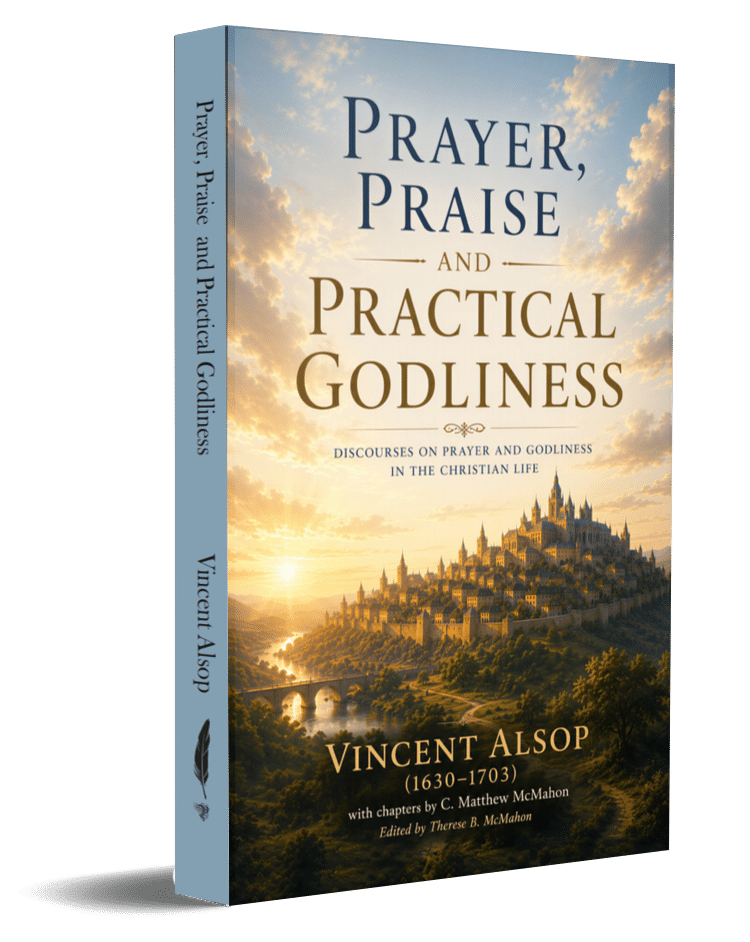
Biography of Vincent Alsop (1630–1703):
Vincent Alsop (1630–1703) stands among the most able and memorable Nonconformist ministers of seventeenth-century England. A Presbyterian pastor, controversialist, preacher, and author, he combined theological conviction with an uncommon sharpness of mind, earning a reputation not only for his learning and pastoral faithfulness but also for his remarkable wit. Few ministers of his generation possessed such an ability to expose error with both force and humor, making him one of the most distinctive voices among the English Dissenters.
Born in Northamptonshire in 1630, Alsop entered St. John’s College, Cambridge, at an early age, where he completed his Master of Arts degree. After receiving episcopal ordination, he accepted a position as assistant master of the free school at Oakham in Rutland. During his younger years, he was known for enjoying lively company and worldly amusements. Yet through the faithful counsel and personal influence of Benjamin King, a godly minister in Oakham, Alsop was brought to a serious commitment to Christ and to the principles of the Presbyterian faith. His attachment to King became even stronger when he married King’s daughter. Convinced that his previous ordination was inadequate, he subsequently received Presbyterian ordination and devoted himself fully to the work of the ministry.
Alsop was presented to the parish of Wilby in Northamptonshire, where he served until the Great Ejection of 1662. Refusing to conform to the requirements imposed by the Act of Uniformity, he joined the ranks of the two thousand ministers who surrendered their livings rather than violate conscience. Like many faithful Nonconformists, he endured years of hardship, preaching wherever opportunities arose and often facing legal penalties for his ministry. On one occasion he was imprisoned for six months simply for praying with a sick person.
His literary reputation was established through the publication of Antisozzo in 1675, a vigorous defense of orthodox Christianity against Socinianism. The work displayed the qualities that would characterize much of his writing—clear reasoning, relentless argumentation, and a lively wit that could dismantle an opponent with remarkable ease. Even those who disagreed with his ecclesiastical convictions acknowledged his gifts. His writings quickly brought him prominence among the Dissenters and led to a call to succeed the respected Matthew Cawton as pastor of a large Presbyterian congregation in Westminster.
From that influential pulpit, Alsop became one of the leading Nonconformist voices in London. He continued to write extensively on the ecclesiastical controversies of his day, defending the cause of religious liberty and the rights of faithful ministers against the pressures of conformity. Works such as Melius Inquirendum and The Mischief of Impositions demonstrated both his theological strength and his ability to expose weak arguments through incisive satire. His opponents often found themselves outmatched not only by the force of his reasoning but also by the quickness of his pen.
Though living and ministering near the center of political power, Alsop largely escaped the harsher punishments endured by many of his fellow Dissenters. During the reign of James II, he became associated with efforts supporting greater toleration for Nonconformists and was involved in the drafting of addresses expressing gratitude for the king’s declarations of indulgence. While some questioned these associations, there can be little doubt that Alsop’s primary concern remained the welfare of Christ’s church and the freedom of the gospel ministry.
Throughout his life he remained a devoted pastor. His popularity as a preacher never diminished, and his gifts made him a sought-after lecturer, including service at the well-known Pinners’ Hall lectures. Even in old age he continued preaching regularly, retaining the vigor, wit, and clarity that had marked his ministry from the beginning. Those who heard him frequently remarked upon the freshness of his mind and the energy of his public labors.
Alsop died on May 8, 1703, after more than four decades of faithful service to Christ and His church. His funeral drew a vast assembly of mourners, reflecting the affection and respect he had earned throughout his ministry.
His surviving works reveal a minister of unusual balance. He was a man of conviction without bitterness, a controversialist without malice, and a defender of truth who understood that wisdom and wit could often accomplish what harshness could not. Whether addressing matters of public duty, prayer, praise, practical holiness, or ecclesiastical controversy, Alsop wrote with vigor, clarity, and pastoral concern. More than three centuries after his death, his writings continue to offer valuable insight into the theology, piety, and courage of the English Nonconformist tradition.
His works:
- Anti-Sozzo (1675)
- Melius Inquirendum: Or, A Sober Inquiry (1678; enlarged 1681)
- An Exercitation on That Historical Relation of the Island Formosa (1680)
- The Mischief of Impositions (1680)
- Alsop’s Speech to King James II (1687)
- Duty and Interest United in Prayer and Praise for Kings and All That Are in Authority (1695)
- Decus et Tutamen: Or, Practical Godliness, the Ornament and Muniment of All Religion (1696)
- God in the Mount: A Sermon on the Wonderful Deliverance of His Majesty from Assassination and the Nation from Invasion (1696)
- A Vindication of the Faithful Rebuke (1698)
- Contribution: “The Mischief of Sin” in The Morning Exercise at Cripplegate (1676)
For Further Study:
Calamy, Life of Baxter, ii. 487 et freq,; Wood, Athenæ Oxon. (ed. Bliss), iv. 106; Kippis, Biog. Brit. i. 167–8; Encycl. Brit.; Wilson, History and Antiquities of Dissenting Churches, iv. 63–66; article by present author in Encyc. Britannica, partly reproduced by permission of Messrs. A. & C. Black.

Help Support APM
